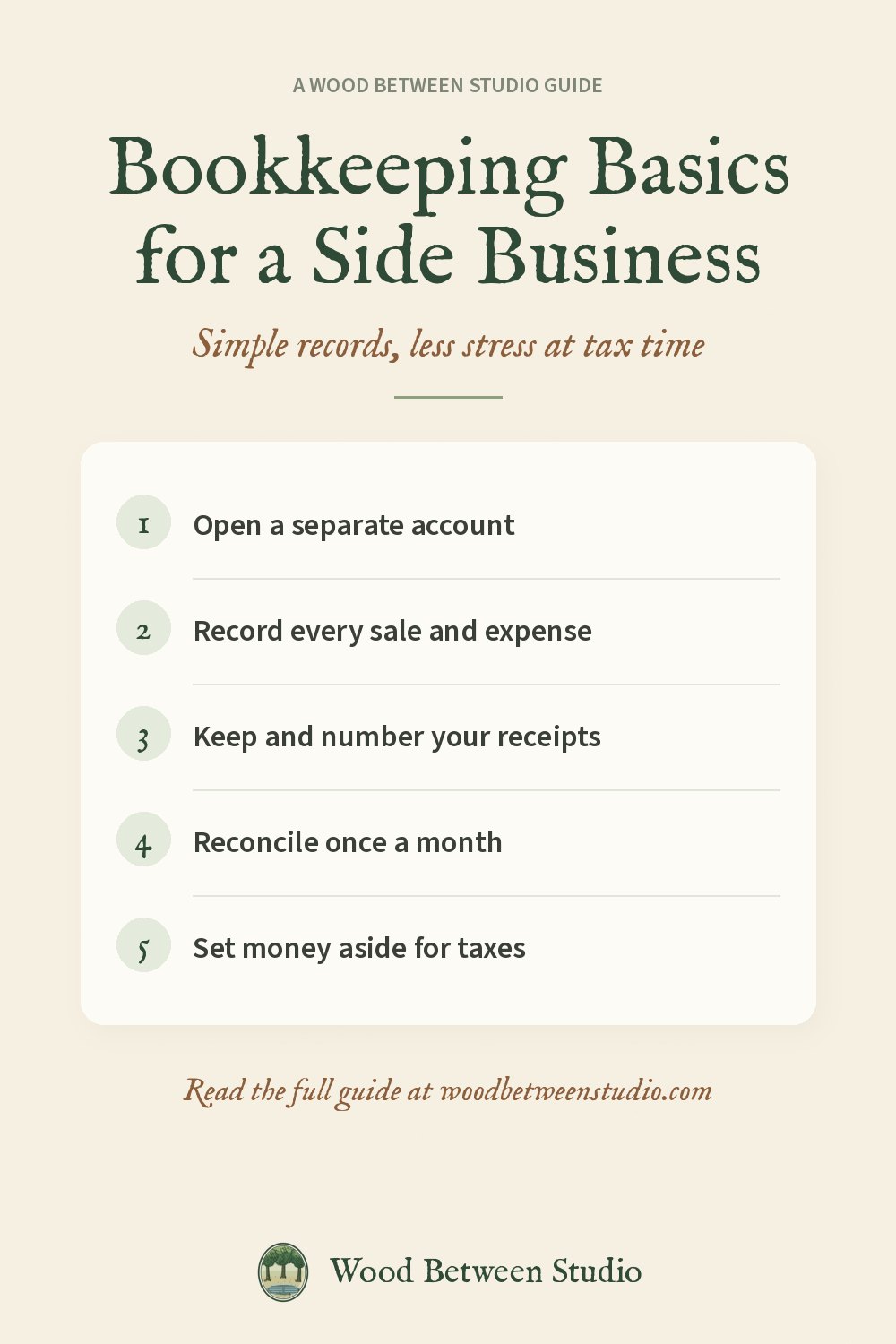
Bookkeeping Basics for a Small Side Business (Not Tax Advice)
Not tax advice: this guide covers general recordkeeping habits for a small side business in the US. It doesn't cover your specific situation. Tax rules change and depend on your circumstances, so confirm the details with a qualified tax professional or at irs.gov.
When your side business is small, bookkeeping can feel like something for "real" companies. But even a modest Etsy shop, a weekend photography gig or occasional freelance work produces income and expenses that need to be recorded. Good records make tax time much easier, show you whether the business is actually making money, and help you answer questions if they ever come up.
The good news: for most small, simple businesses, bookkeeping doesn't need accounting software or a finance background. It needs a few habits, done regularly.
1. Separate business and personal money
This is the single most helpful step. Open a separate checking account (and, if you use one, a separate card) for the business, and run all business income and expenses through it.
Why it matters:
- Your bank statement becomes a near-complete record of the business.
- You don't have to sort through months of groceries and streaming subscriptions to find business expenses.
- It's easier to show which costs were for the business if anyone asks.
It doesn't have to be a formal business bank account if you're a sole proprietor; many people simply use a second personal account kept only for the business. Check with your bank about what they allow.
2. Record every sale and every expense
For each piece of income, note:
- The date
- Who paid you (customer, client or platform)
- What it was for
- The amount
- How you were paid (bank transfer, card, payment app, cash)
For each expense, note:
- The date
- Who you paid
- What it was for
- The amount
- A category (supplies, software, shipping, advertising and so on)
- Whether you have a receipt
If you sell through a marketplace or payment platform, remember that what lands in your bank account is often the amount after fees. Recording the full sale and the fees separately gives a clearer picture of your income and costs.
3. Use a short, consistent list of categories
Pick a set of expense categories and stick with them. For a typical small business, these might include:
- Supplies and materials
- Software and subscriptions
- Advertising and marketing
- Shipping and postage
- Platform and payment fees
- Equipment
- Phone and internet (business share)
- Professional services
- Travel and vehicle
- Education and training
In the US, sole proprietors usually report business income and expenses on Schedule C, so many people choose categories that match its expense lines. That makes it easier for you or your tax preparer to transfer the totals. Ask your preparer which categories they'd find most useful.
4. Keep receipts, and make them findable
A receipt you can't find is almost as unhelpful as no receipt. Choose one system and use it every time:
- Photograph or scan paper receipts on the day you get them.
- Save digital receipts to one folder (for example, "Receipts 2027"), named by date and vendor.
- Give each receipt a number and write that number next to the expense in your records.
Numbering sounds fussy, but it's the quickest way to match an expense to its proof, and to spot any expense that's still missing a receipt.
5. Track mileage if you drive for the business
If you use a personal vehicle for business trips (to clients, the post office, supply runs), keep a log with the date, the purpose, the start and end locations, and the miles. Writing it down at the time is far more reliable than trying to reconstruct a year of trips later. Your tax professional can tell you how vehicle costs may be treated for your situation.
6. Reconcile once a month
Once a month, sit down with your business bank and card statements and your records, and check that they match. For each transaction on the statement, make sure it's in your records with a category. For each item in your records, make sure it appears on a statement (or was paid in cash).
Then check two more things:
- Unpaid invoices: who still owes you, and is it time to follow up?
- Missing receipts: which expenses still need one?
Monthly reconciliation takes thirty minutes or so when the business is small. Leaving it until tax season can take days.
7. Look at your numbers monthly and quarterly
Bookkeeping isn't only for tax time. Totalling income and expenses each month shows your profit (income minus expenses), which categories are growing and which months are busy. Over a few quarters, you'll see patterns that help you plan: when to stock up, when to advertise, and whether a product or service is worth continuing.
8. Plan for taxes during the year
Unlike a paycheck, side business income usually has no tax withheld. That means it's wise to set aside part of every payment in a separate savings account so the money is there when taxes are due. How much depends entirely on your situation, so ask a tax professional for a percentage that makes sense for you.
A few general points worth knowing, all of which you should confirm for yourself:
- The IRS says you have to file an income tax return if your net earnings from self-employment were $400 or more.
- Some self-employed people are expected to make estimated tax payments during the year rather than paying everything at once.
- Many states have their own rules as well.
The IRS Self-Employed Individuals Tax Center is a good place to start reading.
9. Know how long to keep records
The IRS's general guidance is to keep records that support your return until the period of limitations for that return runs out. For many returns that's 3 years from filing, but it can be longer in some situations, and records related to property and employment taxes have their own rules. See the IRS page How long should I keep records? and ask your preparer. Keep copies of your filed returns too.
A simple monthly routine
- Log any income and expenses you haven't recorded.
- File and number new receipts.
- Reconcile against bank and card statements.
- Follow up on unpaid invoices.
- Move your tax set-aside to savings.
- Glance at the month's profit and the year so far.
Tools to keep it simple
A plain spreadsheet with an Income tab and an Expenses tab is enough to start. If you'd like one that's already set up, our Small Business Income & Expense Tracker works in Google Sheets or Excel. It has income and expense logs with your own categories, an optional mileage log, a dashboard with monthly and quarterly profit, an estimated tax set-aside at the percentage you choose, and a flag for expenses that don't have a saved receipt yet. It's an organizing tool for your records, not tax, legal or accounting advice.
If your household budget needs attention too, the free sample planner includes a printable monthly budget page, and our guide on how to make a monthly budget that sticks covers the personal side of the money.
The short version
Keep business money separate, record everything, keep receipts where you can find them, reconcile monthly, set money aside for taxes, and ask a professional when you're unsure. Simple, consistent records are worth far more than complicated ones you never update.