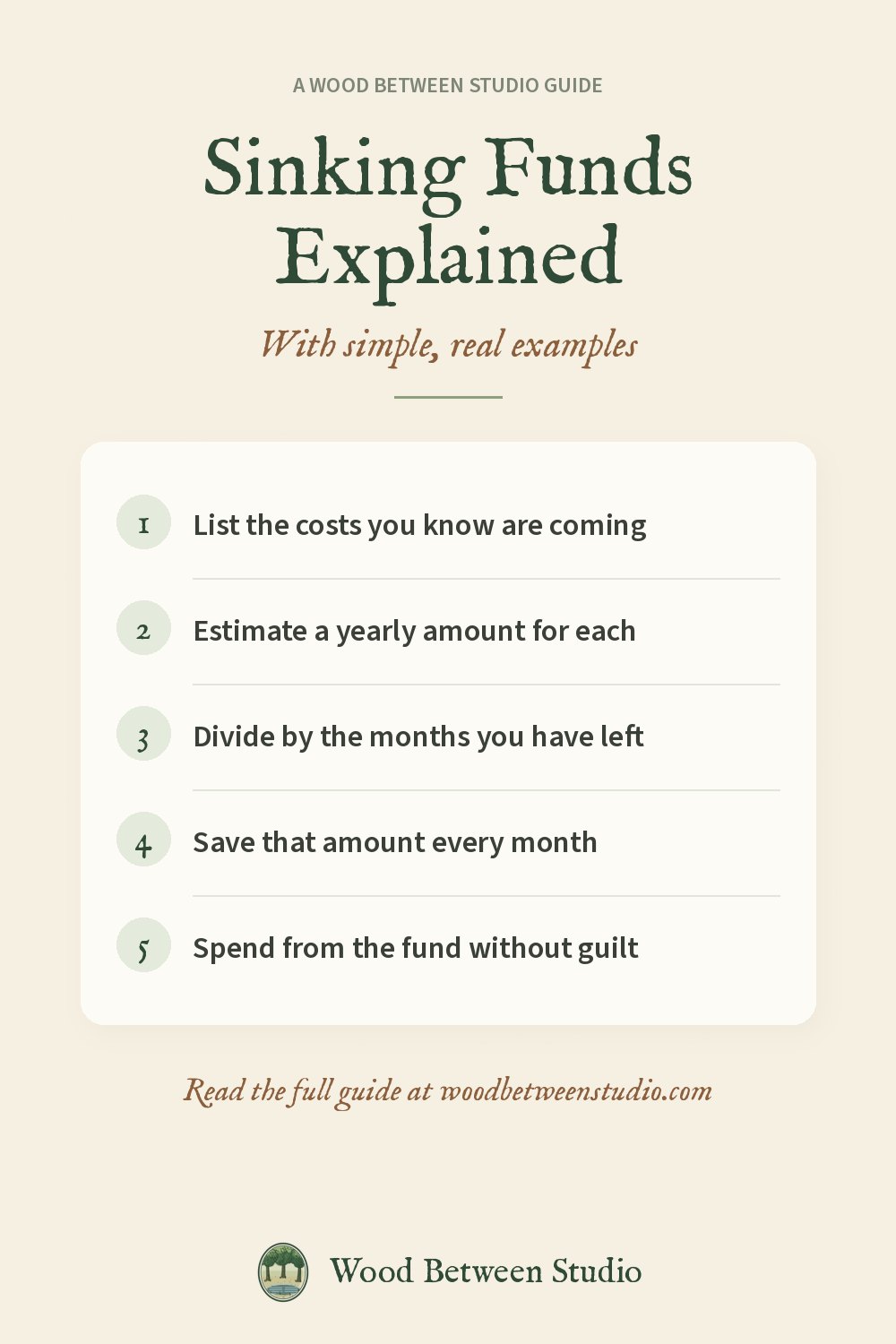
Sinking Funds Explained: What They Are, With Real Examples
If your budget works most months but keeps getting knocked off course by "unexpected" expenses, sinking funds are probably the missing piece. They're simple, they don't need special accounts or apps, and they turn the big, lumpy costs of life into small, steady monthly amounts.
What is a sinking fund?
A sinking fund is money you set aside, a little each month, for a specific expense you know is coming. The expense might be months away, and you might not know the exact amount, but you know it will happen.
Think about car insurance paid every six months, a yearly software subscription, new tires, back-to-school costs, a family wedding or holiday gifts. None of these are true surprises. They just don't show up every month, so a monthly budget tends to forget them until the bill arrives.
With a sinking fund, the bill arrives and the money is already there.
Sinking funds vs. an emergency fund
They work alongside each other but do different jobs:
- An emergency fund is for things you can't predict: a job loss, a medical bill, a sudden large repair. You hope not to use it.
- A sinking fund is for things you can predict, at least roughly. You fully expect to spend it.
Keeping them separate protects your emergency fund. Without sinking funds, predictable costs tend to get paid out of emergency savings, which leaves you less prepared for the real emergencies.
How to set up sinking funds in five steps
1. List the costs you know are coming
Go through the last year of bank and card statements, and your calendar, and write down every expense that isn't monthly. Common ones include:
- Car insurance, registration, maintenance and repairs
- Home or renter's insurance paid annually
- Annual subscriptions and memberships
- Medical, dental and eye care costs
- Pet care and vet visits
- Gifts: birthdays, holidays, weddings, new babies
- Travel and holidays
- School costs and activities
- Clothing and shoes
- Home repairs and replacing appliances
2. Estimate a yearly amount for each
Use last year's actual cost where you have it. Where you don't, make a reasonable guess and round up a little. It's better to overestimate and have a small surplus than to fall short.
3. Divide by the number of months until you need it
If the cost is a year away, divide by 12. If it's sooner, divide by the months you have left. This is the monthly amount for that fund.
4. Add the total to your monthly budget
Add up the monthly amounts for all your funds. This number goes in your budget like any other bill. If the total is more than you can manage right now, start with the funds for the costs that are soonest or most likely to cause trouble, and add the others as you can.
5. Spend from the fund when the cost arrives
When the insurance bill or the vet visit comes, pay it from its fund. This is the point of saving, so there's nothing to feel guilty about. Then keep contributing for next time.
Worked examples
Here's how the math looks for a typical household. These numbers are only an illustration; use your own.
| Fund | Expected cost | When | Monthly amount |
|---|---|---|---|
| Car insurance (paid every 6 months) | $720 | in 6 months | $120 |
| Car maintenance and tires | $900 | across the year | $75 |
| Holiday gifts | $600 | in 12 months | $50 |
| Vet and pet care | $480 | across the year | $40 |
| Annual subscriptions | $180 | in 12 months | $15 |
| Total | $300 |
So in this example, setting aside $300 a month covers $2,880 of costs that would otherwise land as five separate shocks during the year.
Example: starting late
Say it's already June and you want $600 for December gifts. You have six months, so the monthly amount is $100 instead of $50. Starting late isn't a reason to skip the fund; it just means a higher monthly amount this year and a lower one next year once you can start in January.
Example: a cost that varies
Car maintenance might be $150 one year and $1,100 the next. For costs like this, use an average of the last two or three years, and let the balance carry over. A quiet year builds a cushion for an expensive one.
Where to keep sinking fund money
You have a few options, and none is wrong:
- One savings account, tracked on paper or in a spreadsheet. The simplest setup. All the money sits together, and your tracker shows how much belongs to each fund.
- Separate savings accounts or "buckets." Some banks let you create several named savings goals inside one account. That's a nice visual, but it isn't necessary.
- A separate account from your everyday checking. Whatever you choose, keeping the money out of the account you spend from day to day makes it less likely to be used by accident.
If you use one account for everything, a tracker is essential. Otherwise it's easy to look at the total and forget that $720 of it is already promised to your insurance company.
How to track your funds
For each fund, you want to know five things: the target, the date you need it, what's saved so far, what's still needed, and how much to save each month to get there on time.
A simple page with one row per fund works well on paper. If you'd rather not do the division by hand, our Savings Goals & Sinking Funds Tracker works out the monthly amount for up to 20 funds, keeps a running balance as you log deposits and withdrawals, and checks whether your monthly savings budget covers everything you've planned.
Common questions
How many sinking funds should I have? Start with three to five for the costs that cause the most trouble. You can always add more. Too many funds at once can make the monthly total feel impossible.
What if I need to use a sinking fund for something else? It happens. Move the money on purpose, write down what you borrowed from, and adjust the monthly amounts so the original fund catches up.
What happens to leftover money? Let it roll over into the next year for that fund, or move it to another goal. Either way, decide deliberately.
Should I save for sinking funds or pay off debt first? Many people do both: a small amount into the funds for predictable costs, so those costs don't go on a credit card, and the rest toward debt. Our guide to the debt snowball and avalanche methods covers the debt side.
Start with one fund this month
Pick the next predictable expense on your calendar, divide its cost by the months until it's due, and set that amount aside on payday. That's a sinking fund.
If you're building your first budget at the same time, the free sample planner includes a printable monthly budget page with a savings goal box, and our guide on how to make a monthly budget that sticks shows where sinking funds fit into the bigger plan. For a spreadsheet that handles both the budget and your bills, see the Simple Monthly Budget & Bill Tracker.
This guide is general information for organizing your own money, not financial advice.