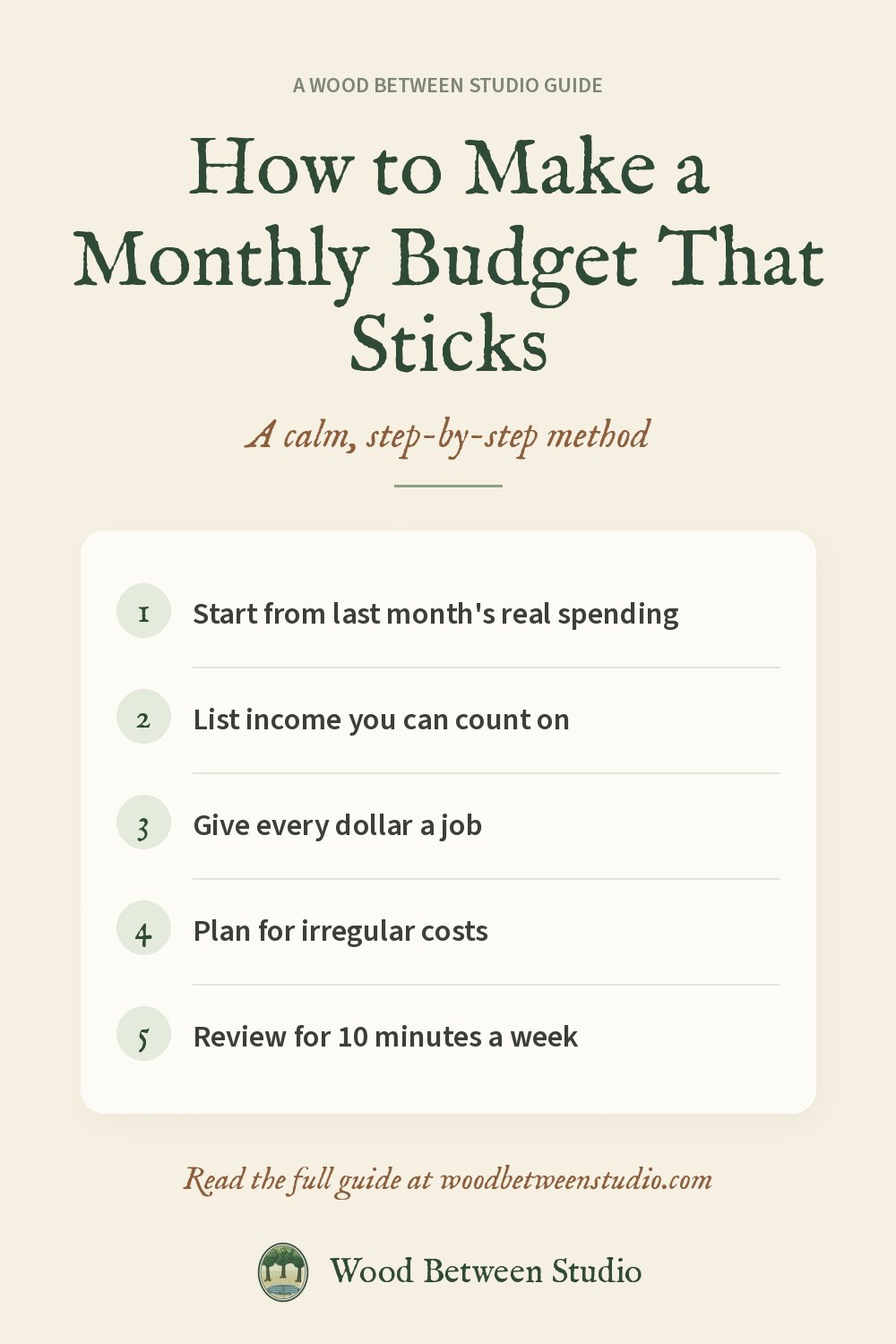
How to Make a Monthly Budget That Actually Sticks
Most budgets don't fail because the math is hard. They fail because the plan was written for an imaginary month: one with no birthday gifts, no car trouble and no tired evenings when takeout wins. A budget that sticks is built from your real life, leaves room for the things that always seem to come up, and takes only a few minutes a week to keep current.
Here is a simple way to build one, step by step. You can do it on paper, in a notebook or in a spreadsheet. The method matters more than the tool.
Step 1: Look back before you plan ahead
Before you write a single budget number, find out what a normal month actually costs you. Pull up the last one to three months of bank and card statements and sort the spending into broad groups: housing, utilities, groceries, transportation, insurance, debt payments, eating out, shopping, subscriptions, gifts and so on.
You don't need to be precise to the cent. You're looking for patterns. Most people find one or two surprises here, often in groceries, eating out or small subscriptions that renew quietly. That's useful information, not a reason to feel bad. A budget built on what you wish you spent will break in the first week. A budget built on what you actually spend can be adjusted a little at a time.
Step 2: Write down the income you can count on
Next, list the money coming in this month. Use take-home pay (after tax and other deductions), not your salary.
If your income varies, because you work shifts, freelance or earn commission, budget from a conservative number: the lowest month in your recent history is a good starting point. Anything you earn above that becomes a bonus you can assign once it arrives, usually toward savings or debt. This one habit removes a lot of month-end stress.
Step 3: List fixed bills and their due dates
Fixed bills are the costs that are the same, or nearly the same, every month: rent or mortgage, insurance, phone, internet, loan minimums, childcare, and subscriptions you're keeping.
Write each one down with its amount and due date. Due dates matter as much as amounts. If most of your bills land in the first week of the month but you're paid on the 15th and 30th, you may need to set aside part of the second paycheck for the next month's early bills. Seeing the dates on one page makes that obvious.
Step 4: Give every dollar a job
Now subtract your fixed bills from your income and divide what's left among your flexible categories: groceries, fuel, household, personal spending, eating out and savings.
The aim is for income minus everything you've planned to equal zero. That doesn't mean spending it all. Savings and extra debt payments are jobs too. It simply means no money is left unassigned, because unassigned money tends to disappear.
If the numbers don't fit, that's normal for a first budget. Look at the flexible categories first. Trim them gradually rather than all at once; cutting groceries in half on paper rarely survives contact with a real week.
Some people like a guideline such as the 50/30/20 split (roughly half for needs, 30% for wants and 20% for savings and extra debt payments). Treat any rule like that as a starting point for comparison, not a pass or fail test. In a high-rent city, needs may take far more than half, and that's reality rather than failure.
Step 5: Plan for the costs that aren't monthly
This is the step that makes the biggest difference. Car repairs, annual subscriptions, insurance premiums paid twice a year, school costs, holidays and birthdays aren't emergencies. They're predictable; they just don't arrive every month.
List each one with a rough yearly cost, divide by 12, and set that amount aside each month. These are often called sinking funds, and there's a full guide to sinking funds with examples if you'd like to go deeper. Once these costs have their own money waiting, they stop wrecking an otherwise good month.
Step 6: Choose a way to track that you'll actually use
The best tracking method is the one you'll do. Some options:
- Paper: write purchases on a monthly budget page and total them weekly. Slow, but very clear.
- Spreadsheet: log purchases with a category and let formulas add everything up. Our Simple Monthly Budget & Bill Tracker works this way in Google Sheets or Excel, with a dashboard that shows what's left in each category.
- Envelope-style: keep a fixed amount for one or two problem categories (often groceries or eating out) in a separate account or as cash, and stop when it's gone.
Whatever you choose, keep it close to where you spend. A tracker you have to remember to open later tends to get abandoned by week two.
Step 7: Review once a week for ten minutes
A weekly check-in keeps a budget alive. Pick a regular time, perhaps Sunday evening with a cup of tea, and do three things:
- Log or check off any spending you haven't recorded.
- Look at each category: on track, ahead or behind?
- Adjust. If groceries ran high, move money from another flexible category and note why.
Moving money between categories isn't cheating. A budget is a plan, and plans get revised when life happens. What matters is that you make the change on purpose rather than finding out at the end of the month.
Step 8: Close the month and carry the lessons forward
At the end of the month, compare what you planned with what you spent. Note the two or three categories that were furthest off and decide whether the budget was unrealistic or the spending was. Then set up next month's budget using those lessons.
Most people need about three months before a budget feels accurate. The first month is a guess, the second is a correction, and by the third you're working from real numbers.
Common reasons budgets stop working
- Too many categories. Twenty-five categories is a lot to track. Start with ten to fifteen and split them later only if it helps.
- No room for fun. A budget with zero personal spending tends to end in a splurge. A small, guilt-free amount for each adult in the household makes the whole plan last longer.
- Forgetting irregular costs. See step five. This is the most common reason a "good" budget falls apart.
- Tracking only at month-end. By then it's too late to change anything. The weekly review fixes this.
- Treating one bad week as failure. Adjust and keep going. The habit matters more than any single month.
Try it this month
You don't need special tools to start. Take last month's statements, a pen and one page, and work through the steps above. If a ready-made layout would help, the free sample planner includes a printable monthly budget page with a category table, an income box, a bill checklist and a savings goal. And if you'd rather have the totals calculated for you, the budget and bill tracker spreadsheet or the Savings Goals & Sinking Funds Tracker can take over the arithmetic.
This guide is general information for organizing your own money, not financial advice. If you're dealing with serious debt or a complex situation, a nonprofit credit counselor or a qualified financial professional can help.