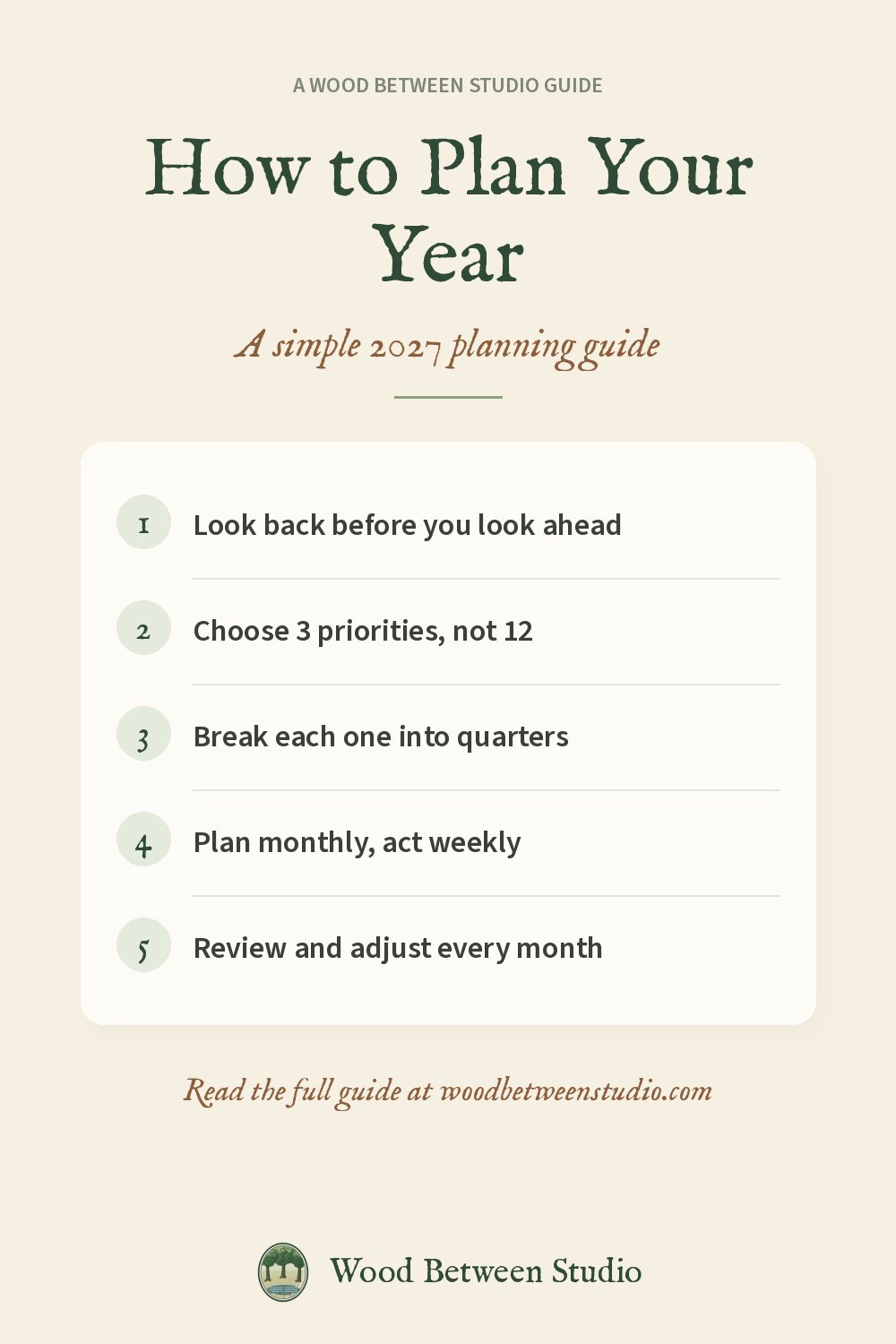
How to Plan Your Year: A Simple 2027 Planning Guide
A new year is a natural time to step back and decide what you want the next twelve months to hold. The trouble is that most yearly plans are either too vague ("get healthier") or too ambitious (fifteen resolutions, all starting on January 1). By February, both kinds have usually faded.
This guide offers a simpler approach for planning 2027. It takes an afternoon to set up and about ten minutes a week to keep going.
Step 1: Look back before you look ahead
Before planning next year, spend half an hour with this one. Get your calendar, your photos, your planner or notes app, and answer a few questions on paper:
- What went well this year? What am I proud of?
- What was harder than expected, and why?
- What took up more time, money or energy than it was worth?
- What do I want more of next year? Less of?
- What did I keep putting off?
You're looking for themes rather than a full report. Often two or three clear patterns stand out, like "I said yes to too many things" or "I felt best in the months I walked every day." These patterns are the raw material for next year's plan.
Step 2: Choose a few priorities, not a long list
Now choose three priorities for 2027. Not ten. Three is enough to make real progress without spreading yourself thin.
A good priority is specific enough that you'd know whether you made progress. Compare:
- "Be better with money" vs. "Build a $1,000 emergency fund and pay off the credit card"
- "Read more" vs. "Read one book a month"
- "Get organized" vs. "Clear and set up the spare room as an office by spring"
It helps to spread priorities across different parts of life, for example one for health, one for money or work, and one for home or relationships. That way, a busy season in one area doesn't stall everything.
For each priority, write one or two sentences on why it matters to you. When motivation dips in March, the why is what you'll come back to.
Step 3: Break each priority into quarters
A year is too long to plan in detail, but a quarter (three months) is just right. For each priority, ask: what would good progress look like by the end of March? By June? September? December?
For example, for "build a $1,000 emergency fund and pay off the credit card":
- Q1 (Jan–Mar): set up a budget, start saving $100 a month, list all debts.
- Q2 (Apr–Jun): emergency fund reaches $600, start extra card payments.
- Q3 (Jul–Sep): emergency fund complete, card balance down by half.
- Q4 (Oct–Dec): card paid off, plan holiday spending in advance.
Quarterly milestones give you natural checkpoints and let you adjust without abandoning the whole plan.
Step 4: Plan monthly, act weekly
At the start of each month, look at your quarterly milestones and choose the two or three actions that move each priority forward this month. Write them down along with the month's important dates: birthdays, appointments, bills, travel.
Then, once a week, look at the month's actions and choose what you'll do this week. Put specific tasks on specific days. "Work on budget" becomes "Tuesday evening: list all monthly bills."
This is where most yearly plans succeed or fail. Big goals happen through small, scheduled actions. If something isn't on a day, it tends not to happen.
Step 5: Turn goals into habits where you can
Some priorities are projects with a finish line, like clearing the spare room. Others are really habits, like walking or reading. For habit-shaped goals, set a small daily or weekly action and track it.
A habit tracker shows at a glance how often you're actually doing the thing, which is more useful than a vague feeling. Our guide to a simple habit tracking method covers how to set one up so it doesn't become another source of guilt.
Step 6: Put the dates in now
Before the year starts, add the fixed dates you already know:
- Birthdays and anniversaries
- Holidays and school breaks
- Bill due dates and renewal dates (insurance, subscriptions, registrations)
- Tax deadlines that apply to you
- Planned trips and big events
Seeing them in advance helps you plan around busy months. It also shows which months need extra money set aside, which is exactly what sinking funds are for.
A small 2027 detail: January 1, 2027 falls on a Friday, so the first "week" of the year is a short one. Many people find it easiest to start their weekly rhythm on Monday, January 4 (or Sunday, January 3 if your weeks start on Sunday).
Step 7: Review monthly, adjust quarterly
At the end of each month, take fifteen minutes to answer:
- What did I do toward each priority?
- What got in the way?
- What will I change next month?
At the end of each quarter, look at the bigger picture. Are these still the right priorities? Life changes. A plan that adjusts is far more useful than one that's followed rigidly or abandoned entirely.
Choosing a planner for 2027
You can do all of this in a notebook. If you'd like a structure that's already set up, our 2027 Planner is fully dated and includes yearly goals, quarterly focus pages, goal plans, a monthly calendar and review for each month, and a page for every week. It's hyperlinked, so it works on a tablet in a PDF app as well as printed at home.
For the habit side of your plan, the Habit Tracker & Monthly Goals set gives you monthly goal pages, a habit plan and a 31-day tracker. And if you'd like to try the style first, the free sample planner includes a weekly planner page and a habit tracker you can print today.
A one-page summary
- Look back: what worked, what didn't, what you want more and less of.
- Choose three priorities with a clear why for each.
- Set quarterly milestones for each priority.
- Each month: choose two or three actions per priority.
- Each week: schedule those actions on specific days.
- Track habits with a simple tracker.
- Review monthly and adjust quarterly.
That's the whole system. It isn't complicated, and it doesn't need to be. The plans that last are the ones that fit into a real week.