Debt Snowball vs. Debt Avalanche: How to Choose (With a Worked Example)
If you have more than one debt, you've probably met the two most common payoff plans: the debt snowball and the debt avalanche. Both work. Both rely on the same core idea. The difference is the order you pay things off, and that order affects how much interest you pay and how motivated you feel along the way.
This guide explains each method, walks through a worked example with real numbers, and helps you choose.
What both methods have in common
The snowball and the avalanche share the same structure:
- Pay the minimum on every debt, every month. This keeps every account in good standing.
- Put any extra money toward one target debt. Even a small extra amount makes a real difference over time.
- When the target debt is paid off, roll its whole payment into the next one. The money you were paying on the cleared debt doesn't go back into your spending. It joins the extra payment and goes to the next target.
That third step is what makes both methods powerful. Each debt you clear makes the next one go faster, because the payment aimed at it keeps growing.
The debt snowball: smallest balance first
With the snowball, you list your debts from the smallest balance to the largest and target the smallest first, regardless of interest rate.
Why people like it: you clear a whole debt quickly. That first paid-off account is a visible win, and for many people that win is what keeps them going for the months or years the full plan takes. It also reduces the number of bills you're juggling sooner.
The trade-off: if a large debt also carries a high interest rate, it sits there growing while you pay off smaller ones, so you usually pay more interest overall.
The debt avalanche: highest interest rate first
With the avalanche, you list your debts from the highest interest rate to the lowest and target the highest rate first, regardless of balance.
Why people like it: it's the mathematically cheapest order. By attacking the most expensive debt first, you reduce the total interest you pay, and you often finish slightly sooner.
The trade-off: if your highest-rate debt is also a big one, it can take a long time before you see any debt fully paid off. Some people find that discouraging.
A worked example
Here are three debts, chosen so the two methods pick a different first target. The numbers are an illustration only.
| Debt | Balance | Interest rate (APR) | Minimum payment |
|---|---|---|---|
| Personal loan | $1,100 | 8.00% | $50 |
| Credit card | $5,200 | 23.99% | $150 |
| Car loan | $8,400 | 6.50% | $250 |
Minimum payments total $450 a month. Suppose you can add $150 extra, for $600 a month in total. Interest is estimated monthly (APR divided by 12) on the remaining balance, and each cleared payment rolls into the next target.
Snowball order: personal loan, then credit card, then car loan.
- The personal loan is paid off in month 6.
- The credit card is paid off in month 23.
- The car loan is paid off in month 29.
- Total interest: about $2,325.
Avalanche order: credit card, then personal loan, then car loan.
- The credit card is paid off in month 22.
- The personal loan is also gone by month 22, because its minimum payments had been chipping away at it all along.
- The car loan is paid off in month 29.
- Total interest: about $2,146.
In this example, the avalanche saves about $179 in interest, and both plans finish in the same month. The snowball, meanwhile, gives you a fully paid-off debt in month 6 instead of month 22.
That's the real choice in a nutshell: a little less interest, or an early win. The gap can be much larger when a big, high-rate debt is involved, and much smaller when your rates are close together.
How to choose
Ask yourself a few honest questions:
- Have you started a payoff plan before and stopped? If so, the snowball's early wins may be worth more to you than the interest savings.
- Is one debt much more expensive than the others? A credit card at 25% or more next to loans at 5–8% makes a stronger case for the avalanche.
- Are your balances and rates fairly similar? Then the difference will be small. Pick whichever order feels better.
- Are you motivated by numbers? If seeing total interest drop keeps you going, the avalanche suits you.
There's also a middle path. Some people clear one very small debt first for a quick win, then switch to the avalanche order for the rest. That's perfectly reasonable. The method you'll stick with is better than the "perfect" method you abandon.
Making either method work
- Find your extra amount. Your budget is where the extra payment comes from. If you don't have one yet, start with our guide on how to make a monthly budget that sticks.
- Stop adding new debt. A payoff plan can't keep up with ongoing new balances. Sinking funds for predictable costs help here, because those costs stop landing on a card.
- Automate the minimums. Set every minimum payment to autopay if you can, then make the extra payment by hand so you see progress each month.
- Track the roll-over. The roll-over is the step people most often forget. When a debt is gone, its payment must move to the next target, not back into everyday spending.
- Review monthly. Update the balances, note what you've paid off, and recalculate your debt-free date. Watching that date move closer is motivating in itself.
Tools to keep it simple
You can run either method on paper with one row per debt. If you'd rather not calculate interest and roll-overs by hand, our Debt Payoff Planner does it in Google Sheets or Excel. Enter up to ten debts, choose Snowball or Avalanche from a dropdown, and it builds the month-by-month schedule, rolls each cleared payment forward, and shows your debt-free date and total interest. Switching the method lets you compare both orders with your own numbers in a few seconds.
To find the extra payment in the first place, the Simple Monthly Budget & Bill Tracker keeps your spending and bills in one place, and the free sample planner includes a printable monthly budget page you can start with today.
The short version
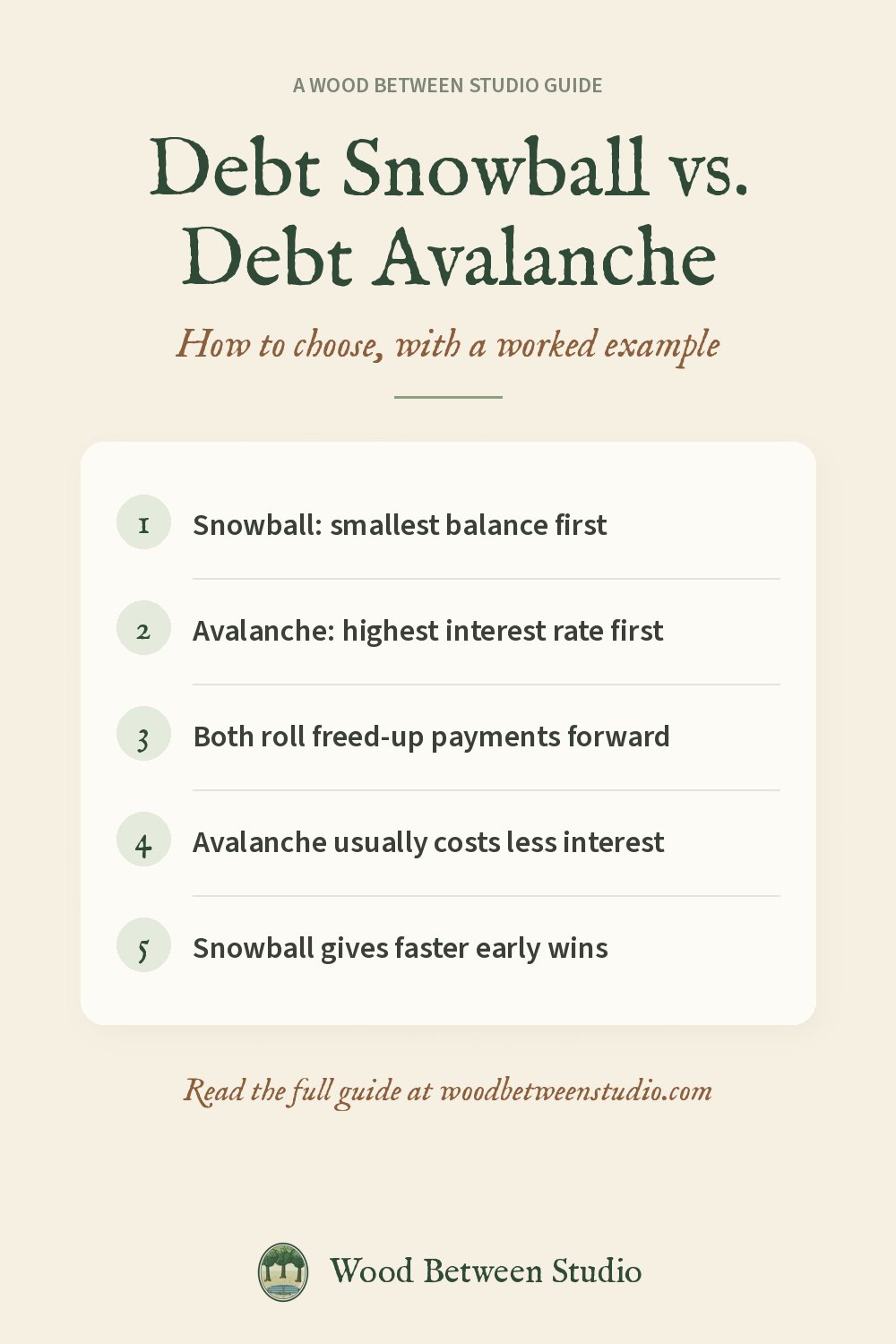
- Snowball: smallest balance first. Faster early wins, usually a little more interest.
- Avalanche: highest rate first. Less interest, but the first win can take longer.
- Both: pay every minimum, send the extra to one target, and roll each cleared payment forward.
Choose the one you'll keep doing. Consistency matters more than the order.
This guide is general information, not financial advice. The worked example uses simplified monthly interest and illustrative numbers. Your lender's actual interest calculation, fees and terms may differ. If debt feels unmanageable, a nonprofit credit counseling agency can help you look at options.