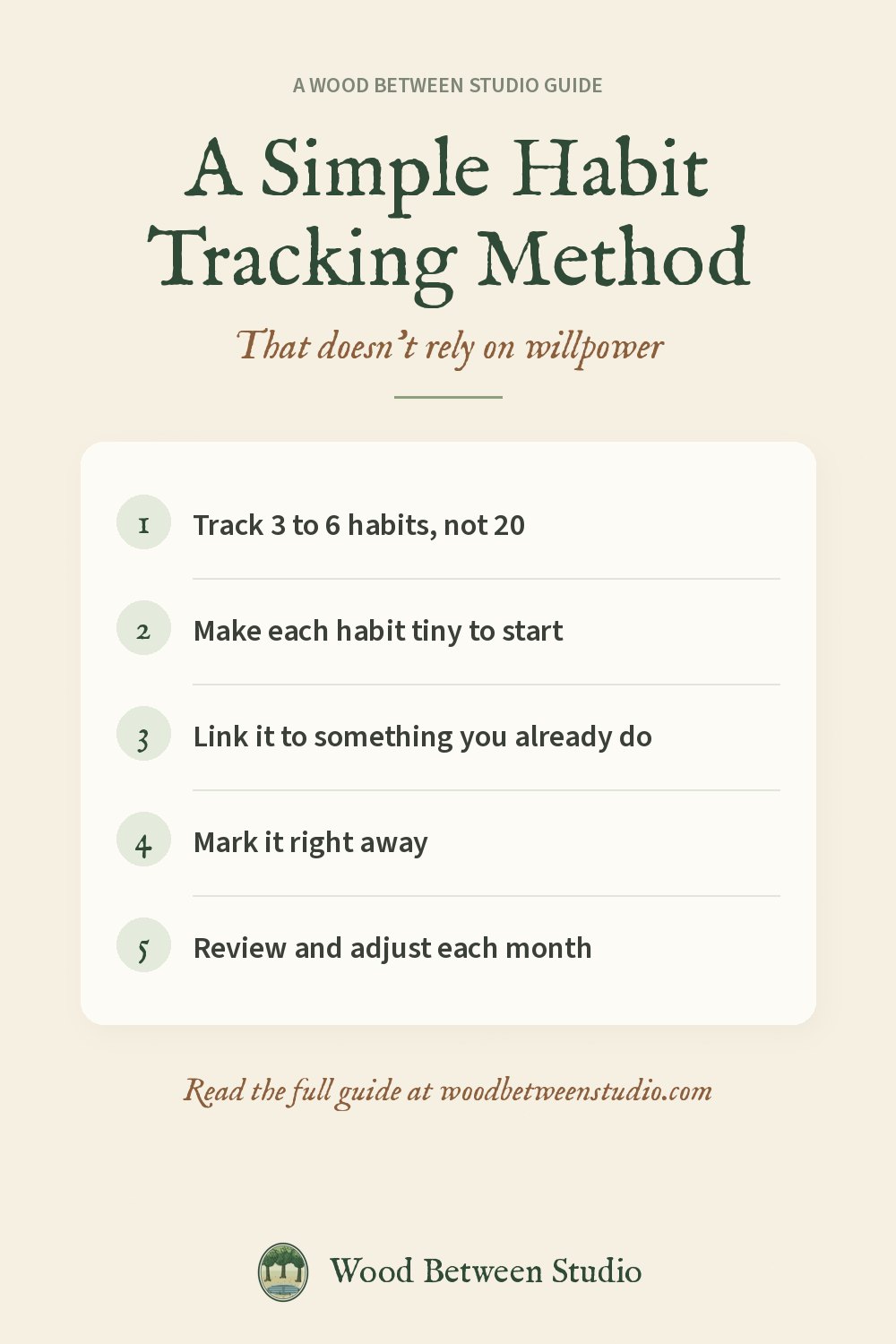
A Simple Habit Tracking Method You'll Actually Keep Using
Habit trackers are simple: a list of habits down one side, the days of the month across the top, and a mark for each day you do the thing. They're also easy to abandon. Most people start with enthusiasm, track twelve habits for a week, miss a few days and quietly stop.
The tracker isn't the problem. The method is. Here's a simple approach that's built to last past the first two weeks.
Why track habits at all?
A tracker does three useful things:
- It makes the habit visible. Seeing the row each day is a small reminder.
- It shows the truth. Our sense of how often we do something is often off. A month of marks tells you what actually happened.
- It creates a small reward. Filling in a square or circle is satisfying, and a growing row of marks is encouraging in itself.
What a tracker shouldn't do is become a scorecard you feel bad about. The method below is designed to avoid that.
Step 1: Choose three to six habits
Fewer is better. Each habit you add takes attention, and attention is limited. Three to six habits is a good range for most people. If you're just starting out, two or three is plenty.
Choose habits that support something you care about. If your priority this year is better sleep, "phone out of the bedroom by 10 pm" is a more useful habit than five unrelated ones. If you've set yearly goals, our guide to planning your year shows how habits connect to bigger priorities.
Step 2: Make each habit small and specific
"Exercise" is hard to track. Did a ten-minute walk count? "Walk for 10 minutes" is clear. You either did it or you didn't.
Start smaller than you think you need to. A tiny version of a habit that you actually do every day builds the routine. You can always do more on good days, but the tracked minimum stays small, so a busy day doesn't break the chain.
Some examples:
- Read one page (not "read for an hour")
- Drink a glass of water with breakfast
- Write down three things I spent money on today
- Two minutes of stretching after brushing teeth
- Lay out tomorrow's clothes before bed
Step 3: Link each habit to something you already do
New habits stick better when they're attached to an existing routine. Use a simple sentence:
After I [existing routine], I will [new habit].
For example: "After I pour my morning coffee, I will read one page." "After I sit down for lunch, I will drink a glass of water." "After I plug in my phone at night, I will lay out tomorrow's clothes."
The existing routine acts as a reminder, so you don't have to rely on remembering or willpower.
Step 4: Make the tracker easy to reach
Put your tracker where you'll see it at the moment the habit happens, or at one fixed time each day. A printed tracker on the fridge or inside a planner you open daily works well. If you have to go looking for it, you'll stop using it.
Mark each habit as soon as you've done it, or at the same time each evening. A two-second check is the goal.
Step 5: Track honestly and kindly
When you miss a day, leave it blank. Don't scribble it out, don't add guilt, and don't "make up" for it by doing double tomorrow. A blank space is simply information.
A helpful rule many people use is never miss twice. Missing one day is normal life. Missing two in a row is the beginning of a new habit of not doing it. If you miss Monday, make Tuesday a priority, even if it's the tiniest possible version.
You can also use a simple code if you like: a filled circle for done, a half-filled circle for the tiny version, and blank for not done. That gives you credit for showing up on hard days.
Step 6: Review at the end of each month
Once a month, look at the whole tracker and ask:
- Which habits stuck? Keep them, and maybe stop tracking the ones that are now automatic.
- Which didn't? What got in the way: the timing, the size, or the reason?
- Is there one habit to adjust, shrink or replace next month?
This review is where the real progress happens. You're not trying to get a perfect month. You're learning what works for you and adjusting.
Step 7: Start fresh each month
Begin each month with a clean tracker. Carry forward the habits that are still in progress, drop the ones that are automatic or no longer matter, and add at most one new habit. Gradual change builds on itself in a way a fresh set of twelve resolutions rarely does.
Common mistakes to avoid
- Tracking too many habits. Attention spreads thin, and the tracker feels like a chore.
- Starting too big. A habit that takes an hour won't happen on busy days.
- Tracking habits you don't care about. If it doesn't connect to something meaningful, it won't last.
- Treating gaps as failure. Gaps are normal. The pattern over the month matters more than any single day.
- Never reviewing. Without a monthly look back, the tracker records but doesn't help you improve.
A sample month
Here's what a realistic first tracker might include:
| Habit | Linked to | Tiny version |
|---|---|---|
| Walk | After lunch | 10 minutes around the block |
| Read | After pouring morning coffee | One page |
| Log spending | After dinner | Note today's purchases |
| Phone away | When I get into bed | Phone on the charger in the hall |
Four habits, each small, each tied to a routine that already happens.
Printable trackers to get started
You can draw a tracker in any notebook. If you'd like one ready to print, the free sample planner includes a monthly habit tracker with room for 12 habits across 31 days, plus a weekly planner page.
For a full set, our Habit Tracker & Monthly Goals includes monthly goal pages, a habit plan page built around the "after I, I will" sentence, a 31-day tracker, a weekly check-in, a thirty-day challenge, a year in pixels and a monthly reflection. If you prefer to keep everything in one book, the 2027 Planner pairs well with it for the weekly side of planning.
In short
Choose a few habits. Make them small. Link them to routines you already have. Mark them right away. Review monthly. And when you miss a day, simply start again the next one.